01
Industry & production
NSHEV halls, PSHEV systems, stairwell SHEV.
Annual testing and maintenance of your smoke and heat exhaust system — all smoke detectors, drives, panels and supply-air paths. Log book, defect report and an immediate offer for remediation from a single source.
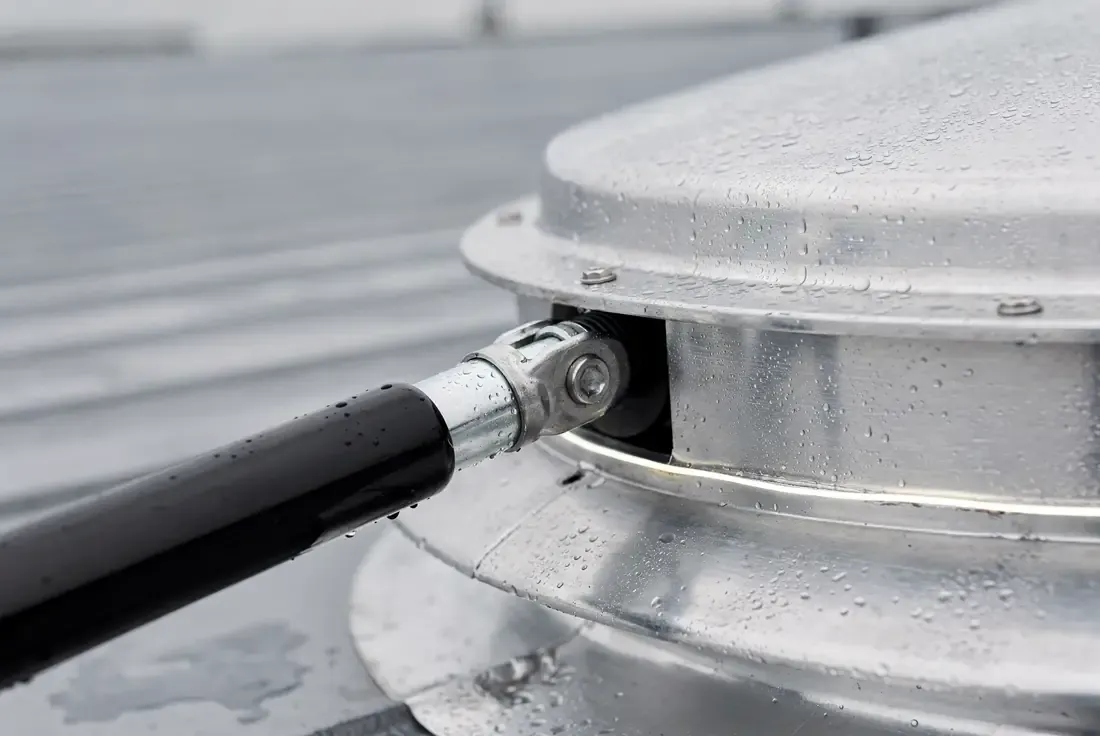
A SHEV is only as reliable as its last maintenance. Motors wear, smoke detectors get dusty, batteries age, supply-air paths get blocked. The operator is obliged under the applicable proofs of usability and the state building code to have the system regularly tested and maintained by a qualified specialist firm — at least once a year, more often for heavily loaded systems. In addition, the operator must perform a monthly visual check (indicator lamps, supply-air paths). Missed maintenance leads to lapse of the DIBt approval and jeopardises insurance cover — management is personally liable in case of damage. We maintain all common SHEV systems brand-agnostically, document every step in the log book and offer immediate remediation for defects — one contact, one responsibility, one documentation.
Which variant fits depends on the installation context, the existing building and the fire-protection concept — we advise per project.
Immediate remediation — trigger disturbed, system non-functional. Operator informed right away.
Time-bound remediation (typically 4–8 weeks). Function limited, but trigger possible.
Note for next maintenance. No functional limitation.
Fans, ducts, control, volumetric flow measurement.
All prices are indicative per maintenance visit, excl. defect rectification. Defects are offered separately.
We cover every typical building type — from residential to industrial complexes with hundreds of components per site.
NSHEV halls, PSHEV systems, stairwell SHEV.
Rooflight-band NSHEV over large areas — often integrated with high-bay racking.
Powered CO ventilation plus extraction.
Smoke curtains, fans, smoke exhaust dampers.
Theatres, halls, event venues — often with a mandatory inspection expert.
Stairwell SHEV and atrium extraction.
Defines what is tested during the annual maintenance — and how.
If the SHEV panel is linked to the FDA.
Maintenance per standard is the prerequisite for keeping the DIBt approval.
Ensure functional capability of all fire protection installations.
Insurers require a complete inspection history in case of a claim.
Structure and order follow applicable proof of usability Annex B. Each step with measured value and finding in the test protocol.
Qualification as a competent person for SHEV systems, manufacturer-certified for all common systems.
Complete inspection history, instantly available, optional access via project portal.
SHEV, fire doors, hold-open devices, fire dampers in the same visit — one invoice process.
On defects, direct offer for remediation — one contact for inspection and repair.
Completeness, fixing, labelling, access.
Each loop individually — test gas, trigger behaviour, sensitivity.
Function, labelling, accessibility at all positions.
Opening, closing, run time, limit switches.
Measurement to full opening in accordance with the applicable proofs of usability or approval.
Doors, flaps and supply-air devices — open on trigger.
Battery status, charge level, self-test of the panel.
If connected: signal exchange and logic with the fire detection panel.
Correct shutdown in storm and rain, if fitted.
All measured values, observations and defects in the test protocol.
Send us your equipment list, location and last inspection date — we respond within 24 hours with a schedule and cost proposal.