01
High-rise
From 22 m top-storey floor level — wall hydrant on every floor at the stairwell landing (Type F or S).
Fire water at the wall — for laypersons (Type S) and the fire brigade (Type F). Planning, installation and pressure testing in accordance with the applicable proofs of usability. For halls, high-rise and special buildings in North Rhine-Westphalia.
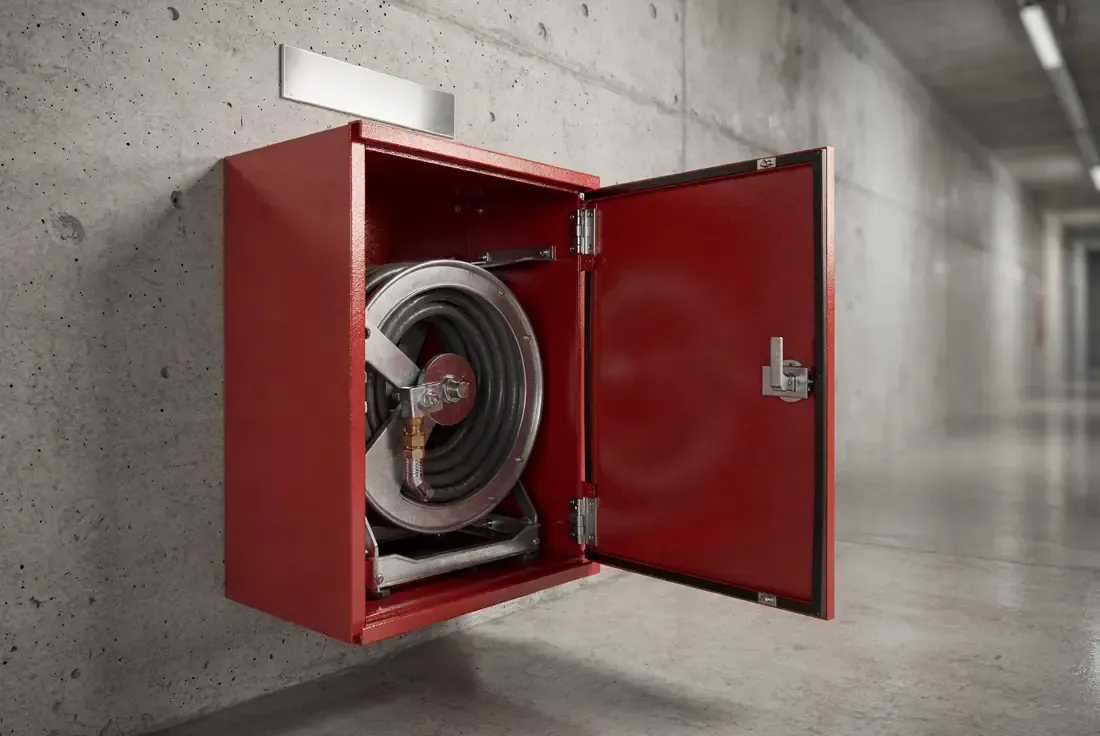
applicable proof of usability distinguishes by user: Type F for the trained fire brigade, Type S for untrained self-help. Which type is required where follows from the fire protection concept.
A wall hydrant is a permanently installed fire-water take-off point in the wall — with shut-off valve, formstable hose and nozzle. applicable proof of usability distinguishes two basic types: Type F (for the fire brigade) with a C-coupling and no hose in the cabinet, fed from a dry or wet riser — and Type S (for self-help, i.e. laypersons) with a permanently installed formstable hose (typically 30 m) that can be used without instruction. Wall hydrants are mandatory in many building types — high-rise (floor level above 22 m in the top storey), underground garages, industrial halls from certain sizes, assembly venues, schools, hotels. Crucial are correct sizing of the fire-water supply (minimum flow, static pressure, flow pressure), frost protection and regular pressure testing in accordance with the applicable proofs of usability and the water supplier's requirements. We plan, supply, install and test — manufacturer-independent, with full documentation and direct coordination with building services and the fire brigade.
| Type F | Fire brigade | C-coupling 52 mm for connecting the fire brigade hose. No hose in the cabinet. Fed from a dry or wet riser. |
| Type S | Self-help | Formstable hose 30 m with nozzle — immediately usable, also for laypersons. Maximum flow loss per curve. |
| Type F+S | Combined | Double wall hydrant with F and S fittings in one cabinet — economical variant for mixed use. |
| Dry riser | Dry line | Dry riser with external feed — water only in the event of an emergency. For high-rise and frost-prone areas. |
Which variant fits depends on the installation context, the existing building and the fire-protection concept — we advise per project.
Flush in masonry or drywall, discreet and narrow — for representative areas.
Quickly installable, accessible — typical in industry and warehouse.
Formstable hose on a rotating reel — pulls out easily, does not block.
Wall hydrant and fire extinguisher in one cabinet — saves space and signage.
Permanently water-filled, frost-protected routing — immediately ready for use.
Filled only in the event of use (fire brigade infeed) — in frost risk or long runs.
Prices are indicative, excl. planning and structural fees and VAT. Binding after site visit.
We cover every typical building type — from residential to industrial complexes with hundreds of components per site.
From 22 m top-storey floor level — wall hydrant on every floor at the stairwell landing (Type F or S).
Halls above certain sizes per IndBauR NRW — mostly Type S.
High-bay warehouses and logistics halls — wall hydrants combined with sprinklers.
Per Garage Ordinance — Type F in stairwells and access ramps.
Theatres, event halls — wall hydrants in backstage and ancillary rooms.
Per Accommodation Ordinance — Type S on every floor.
Planning and execution standard — types, components, dimensions.
Protective measures against contamination and backflow, pressure testing.
Product standard for the permanently installed hose in Type S.
European minimum requirements for wall hydrant systems.
Hygienic requirements for the fire-water supply.
Fire-water supply as part of the structural fire protection infrastructure.
One point of contact for the entire fire-water infrastructure — planning, installation, handover and annual testing.
Pipework and sanitary installation included — no interface to the sanitary trade.
We choose fittings based on object and use, not margin.
applicable proof of usability testing and leak proof — from a single source.
Annual testing as an ongoing task — bundleable with fire-door and SHEV maintenance.
Number, position, type, volumetric flow — coordinated with the fire protection concept and the water supplier.
Wet or dry riser, infeed, safeguarding in accordance with the applicable proofs of usability.
Cabinets, fittings, hoses, nozzles — manufacturer-independent, matched to the object.
Leak and pressure testing in accordance with the applicable proofs of usability, handover protocol.
Annual functional and pressure test, hose exchange, documentation.
Adding to, replacing or converting existing systems — also during operation.
Send us floor plans, building height and occupancy description — we respond within one business day with an initial assessment and cost frame.