
01
Industry & logistics
Steel halls, primary structures, machine enclosures, smoke and heat extraction ducts.
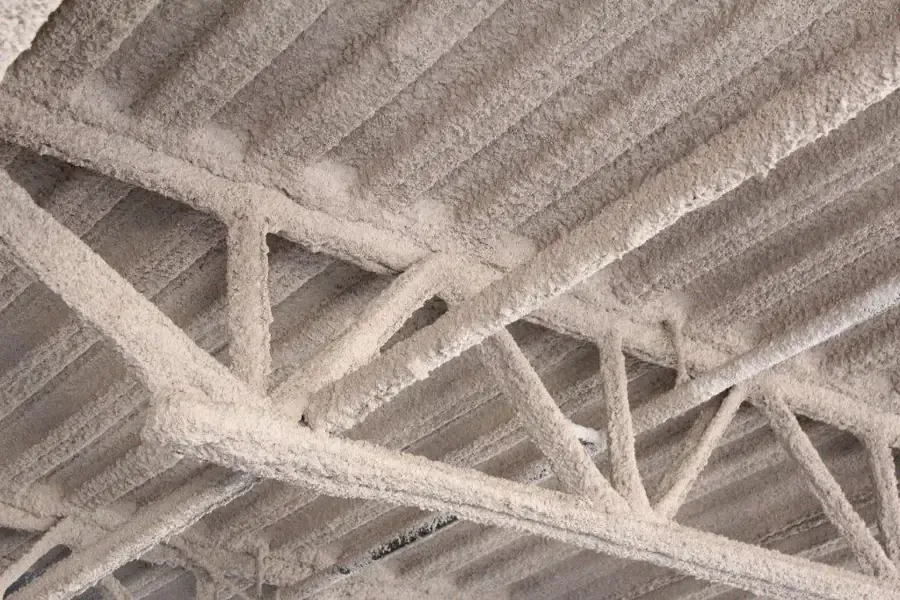
F30 to F90 cladding for steel beams, steel columns, ventilation and smoke-extraction ducts, cable trays and enclosures for server rooms or transformer stations. We install certified systems from all common manufacturers — as board cladding, intumescent coating or encasement.
Under German applicable proof of usability the classes are F30 / F60 / F90 (fire-retardant / highly fire-retardant / fire-resistant). Under European applicable proof of usability the parameters are R (load-bearing capacity), E (integrity) and I (insulation) — combined as REI depending on the application.
Fire-protection cladding (also called fire-protection encasement) protects components that would lose their function in a fire — above all steel structures. Steel loses its load-bearing capacity dramatically above about 500 °C; an unprotected steel beam fails in a full fire after 10 – 15 minutes. The cladding keeps the critical temperature back for the required duration — 30, 60 or 90 minutes. Classification follows applicable proof of usability (F30/F60/F90) or, in European terms, applicable proof of usability with the parameters R (load-bearing capacity), E (integrity) and I (insulation). Which system suits depends on the component (beam, column, duct, tray), the section factor, the required class and the installation situation — we clarify this during planning.
| F30 | 30 minutes | Fire-retardant. Secondary components, non-load-bearing partitions, offices and commercial buildings with lower fire loads. |
| F60 | 60 minutes | Highly fire-retardant. Industrial buildings with higher fire loads, server rooms, archives, intermediate ceilings in special-use buildings. |
| F90 | 90 minutes | Fire-resistant. Load-bearing and bracing components in industrial buildings, fire walls, high-rise buildings per § 28 BauO NRW. |
Each component type has its own system. We select and install what matches your fire-protection concept and your building fabric.
Load-bearing steel structures in halls, high-rise buildings and car parks. Board cladding with approved fire-protection boards or intumescent coating for R30 to R90.
Ducts must retain their function in a fire — for smoke extraction or supply/exhaust air. Tested claddings in accordance with the applicable proofs of usability.
Functional integrity in accordance with the applicable proofs of usability for safety-relevant cables (E30 / E60 / E90). Board cladding or encasement where a classic penetration seal is not appropriate.
Complete room separation for server rooms, transformer stations, emergency-power units or gas-extinguishing rooms — fire-separated inside or outside.
Cladding of timber columns, beams or ceilings during conversion, storey additions or retrofit requirements from the fire-protection concept.
Individual pipes, units, machinery or busbars — wherever a classic penetration seal is not sufficient.
All prices net, excluding scaffolding and lifting equipment. Volume discounts above certain quantities.
Fire-protection cladding is needed wherever steel, timber or duct components must retain their function in a fire.
Steel halls, primary structures, machine enclosures, smoke and heat extraction ducts.
Steel beams and columns in open and closed parking structures — frequently R30 or R90.
Enclosures, cable claddings, functional integrity for network and UPS trays.
Steel beams in intermediate ceilings, columns in foyers, architecturally visible steel structures with intumescent coating.
Special-use buildings with elevated fire-protection requirements — enclosures, cable and duct claddings.
Retrofit in existing buildings, conversions, heritage-protected structures with visible refurbishment.
German classification for components — F30, F60, F90 as fire resistance classes.
European parameters R (load-bearing capacity), E (integrity), I (insulation) — combined depending on the component.
Proof of protective effect for steel beams and columns with boards (Part 4) and reactive coatings (Part 8).
Fire resistance testing for ventilation and smoke-extraction ducts.
Requirements for cable claddings for safety-relevant lines (E30 / E60 / E90).
Legal framework in NRW — supplemented by special-use regulations for industry, assembly halls and hospitals.
From system selection through installation to hand-over documentation — one point of contact for the entire trade.
Installer training from the leading system manufacturers — current certificates, approval-compliant installation.
Beams, columns, ducts, trays, enclosures — one specialist for the complete trade.
Penetration seals, doors, gates and cladding from one source — no interface discussions.
Declarations of conformity, system data sheets, photo documentation for hand-over and insurance.
Which system for which requirement — boards, coating or encasement. Matched to section factor, class and installation situation.
Cladding with approved fire-protection boards — screwed, screw-bonded or butted, per manufacturer specification.
Reactive coatings for visible steel beams — clean, slim, architecturally appropriate.
Ventilation, smoke-extraction and functional-integrity systems in accordance with the applicable proofs of usability.
Complete room fire separation for plant rooms, server rooms and emergency-power units.
Declaration of conformity, system data sheets, photo documentation, hand-over with surveyor on request.
Cable and pipe penetration seals — for penetrations through walls and ceilings.
Cladding and closures for a fire compartment belong together.
Regular visual inspection of cladding as part of the maintenance strategy.
Professional installation of all fire-protection trades.
Send us plans, component dimensions or photos of your steel structure — we reply within 24 hours with an assessment or a survey appointment.