
01
Residential
Apartment buildings, stairwells, transitions to boiler rooms and underground garages — usually with smoke-protection properties.
Panic devices in accordance with the applicable proofs of usability, emergency-exit hardware in accordance with the applicable proofs of usability, electrically locked escape doors with access control, auto-opening in fire case. Planning, install, annual test.
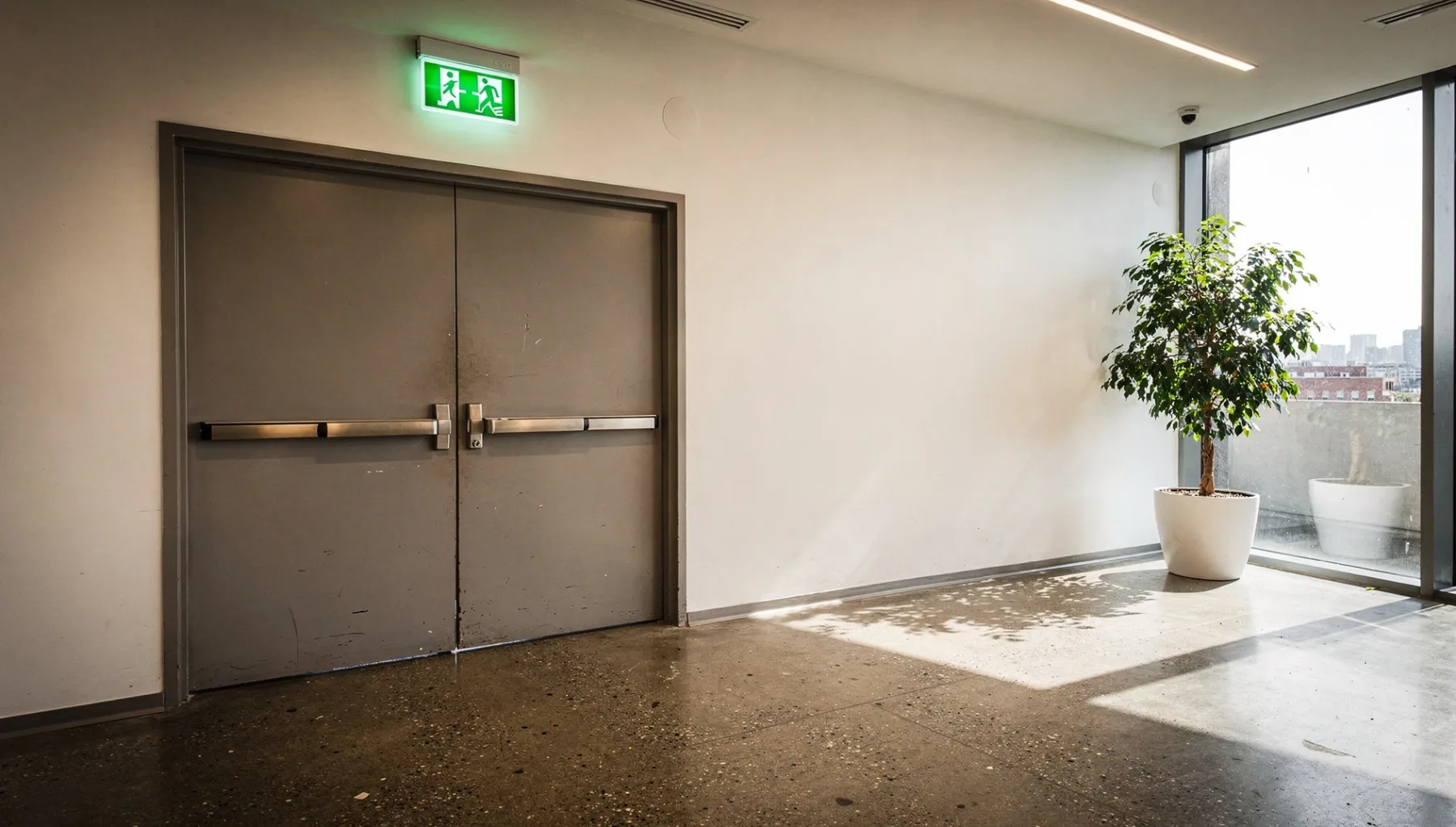
Escape-route systems must open in the direction of escape, without tools and without prior knowledge. applicable proof of usability regulates emergency-exit hardware (lever / push pad) for trained users; applicable proof of usability regulates panic devices (horizontal bar) for untrained users in public buildings. Electrically locked escape doors are allowed under defined conditions per EltVTR.
Which variant fits depends on the installation context, the existing building and the fire-protection concept — we advise per project.
Horizontal push bar across the door. Mandatory in assembly buildings, schools, shopping centres — where untrained users must open.
Classical lever or push pad. Allowed in offices, commercial — where users know the door.
Locked by e-strike or magnet, unlocked automatically in fire or power failure. Combined with access control and alarm.
Central control of all electric escape doors — with release button, optical/acoustic signal, alarm-linked release.
All prices excl. VAT. Maintenance contracts are quoted on a per-unit basis.
We cover every typical building type — from residential to industrial complexes with hundreds of components per site.
Apartment buildings, stairwells, transitions to boiler rooms and underground garages — usually with smoke-protection properties.
Separation of production, storage and administration plus protection of mechanically loaded plant.
Schools, hospitals and administrative buildings under NRW special-buildings regulations — often combined with hold-open systems.
Lever or push-pad hardware for trained users.
Horizontal bars for untrained users in public buildings.
Building-code guideline for electrically locked escape doors.
Workplace rule — route length, width, marking.
Requirements for escape-route signage and lighting.
NRW-wide, exclusively with our own installers — no subcontractors.
Aachen to Bielefeld, Lower Rhine to Sauerland — survey usually within five working days.
No subcontractors. Warranty work and maintenance always trace back to the same people.
We schedule appointments proactively. Inspection record for the fire authority comes with every visit.
Review building class, assembly, escape length, occupancy. Result: required system in accordance with the applicable proofs of usability or applicable proof of usability.
Install by authorised technicians, coordination with existing fire door, label.
Plan control unit, integrate alarm and access control, handover per EltVTR.
Functional test of panic device, electric release, battery backup — protocol for insurer.
We clarify the compliant requirement (applicable proofs of usability), plan the electric controls and hand over inspection-ready.