
01
Industry & production
Halls with process ventilation, extract from paint booths and welding cabins — K90 as standard, usually motorised with alarm-panel interface.
Ventilation ducts are a building's silent fire paths. Fire dampers close them automatically in the event of fire, preventing flames and smoke from crossing into adjacent fire compartments via the ductwork. We design, supply, install and maintain dampers under the applicable proofs of usability — throughout North Rhine-Westphalia.
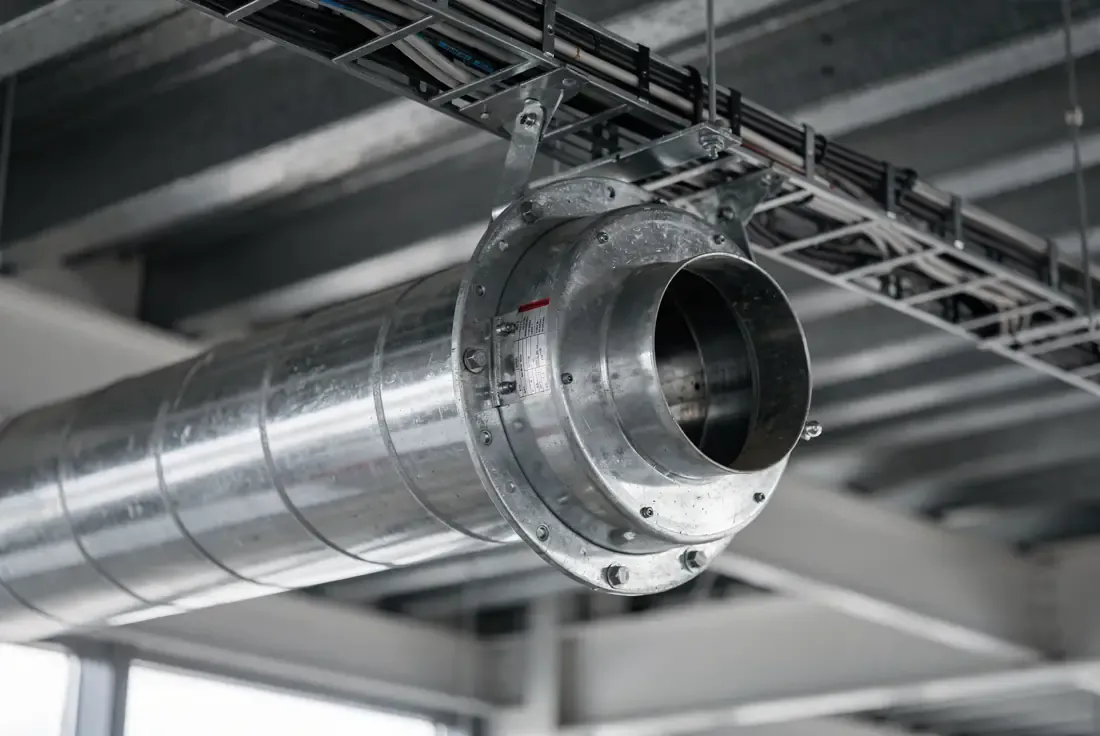
The damper's fire-resistance rating must be at least equal to that of the penetrated element. Nationally classified under the applicable proofs of usability (K), and harmonised across Europe under the applicable proofs of usability (EI … S).
Fire dampers are self-closing shut-off devices in ventilation and HVAC systems. They sit at every point where a duct crosses a fire-resistant wall or ceiling and seal that opening within seconds in the event of fire. Release is either purely thermal via a 72 °C fusible link, or electrical via the fire alarm system. Without working dampers, the ventilation network defeats the compartmentation of the building — fire, smoke and heat would spread unhindered.
| K30 | 30 minutes | For penetrations through F30 walls and ceilings — standard in residential and smaller commercial buildings. |
| K60 | 60 minutes | For F60 elements — rare in practice, mostly in special-purpose buildings. |
| K90 | 90 minutes | The industrial and special-building standard. Required for penetrations through F90 fire walls, stairwell walls and most compartment walls. |
| K120 | 120 minutes | For fire walls with the highest requirement class — hospitals, large buildings, security-critical infrastructure. |
Which damper fits depends on duct geometry, installation location and the interface with the fire alarm panel.
Standard construction for classic rectangular ducts in commercial and industrial buildings. Available up to around 1,600 × 800 mm.
For spiral ducts — more compact, easier to install, widespread in office and residential buildings. Nominal sizes DN 100 to DN 630.
Purely mechanical via a 72 °C fusible link — works without power, no alarm-panel wiring required. Standard for stand-alone buildings.
Electric spring-return actuator, triggered by smoke detector or central fire alarm panel. Required for buildings with alarm-monitoring duty.
Open in a fire to draw off smoke — part of mechanical smoke-extraction concepts. Different function from a fire damper, often fitted in the same duct network.
For control rooms and maintenance records: OPEN / CLOSED feedback to BMS or alarm panel. A prerequisite for remote monitoring.
For a firm fixed price, we survey the duct network on site and coordinate the design with your ventilation engineer or technical building services.
We cover every typical building type — from residential to industrial complexes with hundreds of components per site.
Halls with process ventilation, extract from paint booths and welding cabins — K90 as standard, usually motorised with alarm-panel interface.
Central ventilation systems with duct networks across several floors — dampers at every floor slab and stairwell wall.
Strict requirements under special-building codes, often K120 with full alarm-panel connection including feedback.
Separate garage ordinance, mixed smoke-extract and fire dampers, special approvals for CO and smoke release.
Grease-laden extract brings special requirements — dedicated cleaning and test intervals, often combined with explosion protection.
Internal bathrooms and WCs with mechanical extract under the applicable proofs of usability — K30 dampers at every dwelling boundary.
Harmonised European standard for fire dampers — the basis for CE marking and declaration of performance.
Governs the EI … (ve,ho-i↔o) S rating — gradually replacing the national K classification.
Test standard for proving fire-resistance duration — the basis for every approval.
Defines the original K classes (K30 to K120) — still valid for existing approvals and retained assets.
Defines requirements for extract from windowless bathrooms — mandatory application for fire dampers in residential buildings.
Technical rules for HVAC systems, including requirements for maintenance, hygiene and documentation.
We look after fire dampers across the full life cycle — new installation, retrofit, maintenance, inspection, replacement.
We design and install dampers from every major brand — manufacturer-independent. Selected for the building, not from stock.
Those who install, maintain. It removes interfaces, and warranty and service records live in a single file.
We coordinate with your electrician and alarm-panel installer — from wiring through to commissioning with a joint function test.
Every damper we fit is accessible and labelled — required under the applicable proofs of usability, but often neglected.
Damper positions derived from the compartmentation plan, dimensioned by airflow, selection between thermal and motorised.
Installation in solid walls, light-weight walls or ceilings — following the manufacturer's approval, including access hatch and labelling.
Retrospective integration into existing duct networks — following fire-safety orders, a change of use or an expert's report.
Six-monthly function test via trip release — logged in the test record. Can be extended to annual intervals on proof of twelve months without fault.
Annual inspection by a certified expert with written record — a duty of the operator and the basis for insurance cover.
Replacement of corroded or no longer approved dampers, conversion from thermal to motorised when a fire alarm panel is added.
Cable, pipe and combined seals — often in the same wall opening as the damper.
Fire-resistant encasement of ventilation ducts under the applicable proofs of usability where a damper is not possible.
Electromagnetic hold-open systems with alarm-panel interface — same test regime, same contact.
Service contract bundling all fire-protection assets — dampers can be included.
Received a fire-safety order? Retrofit of dampers, doors and penetration seals in a single contract.
Duties, intervals and inspection regime for every fire-protection asset at a glance.
Send us the quantity, construction type and site — or let us survey the existing installation on site. We come back within 24 hours with a firm proposal.