01
Industry & production
Halls from 1,600 m², production plants with elevated fire load, stores with hazardous materials.
Natural smoke vents (NSHEV), powered smoke exhaust (PSHEV) and stairwell extraction in accordance with the applicable proofs of usability. We plan, supply, install and maintain — tested, documented, insurable.
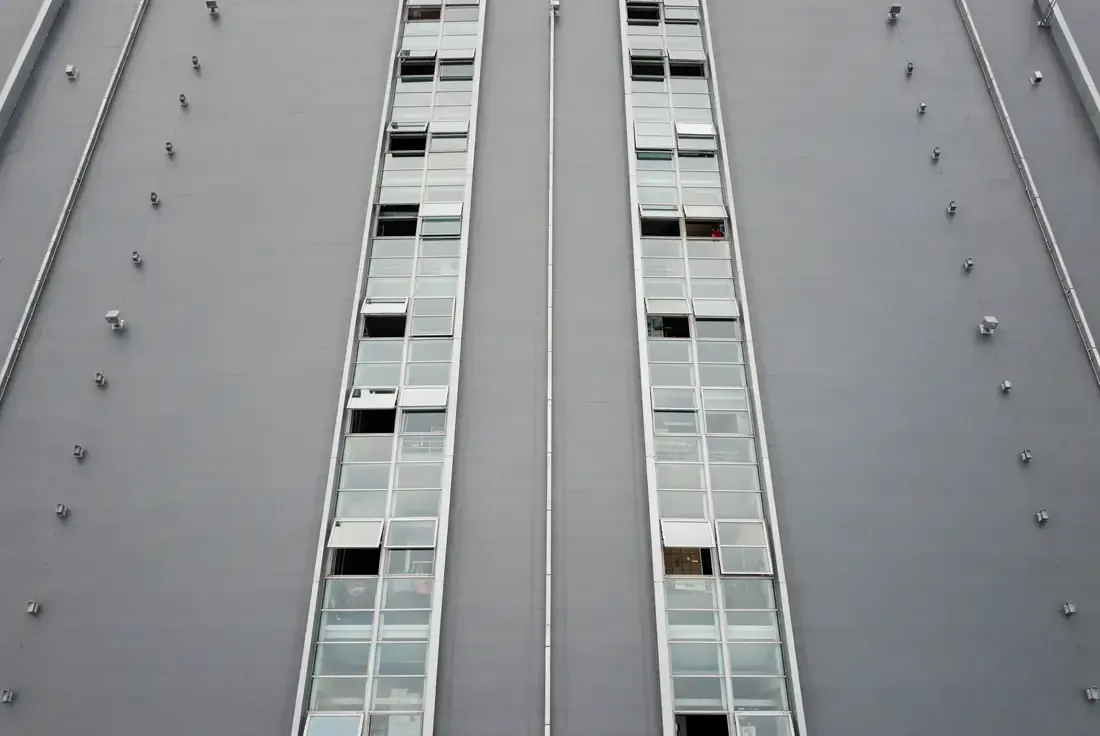
Which SHEV type is suitable depends on geometry, use and the fire protection concept. NSHEV are usually the most economical solution — provided room height and roof area are sufficient.
A smoke and heat exhaust system (SHEV, German: RWA) channels hot smoke and heat out of a building in a controlled way during a fire. The aim is a smoke-free layer at floor level — so people can escape, fire brigades can orient themselves and firefighting can take place. A distinction is made between natural smoke vents (NSHEV in accordance with the applicable proofs of usability), which work by thermal buoyancy, and powered smoke exhaust (PSHEV in accordance with the applicable proofs of usability), which uses certified fans and air ducting. A special case is stairwell SHEV to secure the first escape route, and pressurisation systems (applicable proof of usability), which build up overpressure in the stairwell to prevent smoke ingress. The requirements come from the fire protection concept, the state building codes and the special building ordinances — in NRW notably the Industrial Building Guideline (IndBauR NRW), the Assembly Venue Ordinance (VStättVO) and the Sales Venue Ordinance. Every SHEV must be verified in calculation in accordance with the applicable proofs of usability, regularly maintained and its functional evidence documented completely — otherwise the approval lapses.
| NSHEV | Natural | Smoke and heat exhaust devices in the roof or facade — working by thermal buoyancy. Typical for warehouses, logistics, production. |
| PSHEV | Powered | Fan-assisted extraction — for spaces without sufficient buoyancy, underground garages, kitchens, internal units. |
| Stairwell SHEV | Stairwell | Smoke vent at the top point of the stairwell — keeps the first escape route smoke-free per the Model Building Code. |
| PSSS | Pressurisation | Pressurised smoke protection system — active overpressure in the stairwell prevents smoke ingress. For high-rise and special buildings. |
SHEV devices exist for every roof shape and building geometry. The aerodynamic effective opening area in accordance with the applicable proofs of usability is decisive.
Single unit on the flat roof — with upstand and motorised opening dome or flap.
Continuous rooflight band with opening segments — for large halls, production buildings, logistics.
Vertically opening facade windows or flaps — for assembly spaces, atria and lightwells.
Axial, radial or roof fan with certified temperature resistance (F200 to F600).
Motorised roof hood or louvre at the top stairwell point — code-compliant per MBO § 35.
Control and energy centre with backup power, manual call button, smoke-detector loops and window motors.
Prices are indicative, excl. planning fees and VAT. Binding after sizing calculation and site survey.
We cover every typical building type — from residential to industrial complexes with hundreds of components per site.
Halls from 1,600 m², production plants with elevated fire load, stores with hazardous materials.
High-bay warehouses, dispatch halls, transshipment hubs — IndBauR NRW requires SHEV above certain hall areas.
Theatres, halls, convention centres with ≥ 200 visitors — VStättVO NRW.
Shopping centres and supermarkets from 2,000 m² sales area — VkVO NRW.
Parking facilities with more than 20 spaces — NRW Garage Ordinance.
Every required stairwell needs a smoke vent at its top (MBO § 35).
Verification method for natural SHEV. Calculating the aerodynamic effective area.
Calculation method for PSHEV. Volumetric flow, layout, fans.
Product standard. Classification by temperature, wind, snow and durability resistance.
Test conditions for fans in fire case (F200 to F600).
Pressurised smoke protection systems for stairwells, rescue tunnels, airlocks.
Mandatory triggers for SHEV by occupancy — industrial, assembly and sales venues.
One point of contact for planning, execution and operation — no interface losses between general contractor, consulting engineer and maintenance firm.
In-house sizing calculation with aerodynamic effective area — no interface to an external specialist.
Manufacturer-trained fitters for all common SHEV systems — with current certificates.
Service area all of NRW — short journey times in emergencies or faults.
Sizing calculation, installation protocol, log book — digital and optionally via project portal.
Calculation of the aerodynamic effective area in accordance with the applicable proofs of usability, coordination with the fire safety expert.
Brand-agnostic — all common SHEV systems, CE-compliant and tested per the applicable proofs of usability.
Assembly incl. control cabling, wiring, smoke detectors and SHEV control panel. Handover with protocol.
Testing in accordance with the applicable proofs of usability, defect report, retrofitting.
Replacing defective drives, panels, smoke detectors — also during operation.
24/7 on-call for faults and alarms across North Rhine-Westphalia.
Send us your building description, occupancy and drawings. We respond within one business day with an initial sizing idea and cost frame.