
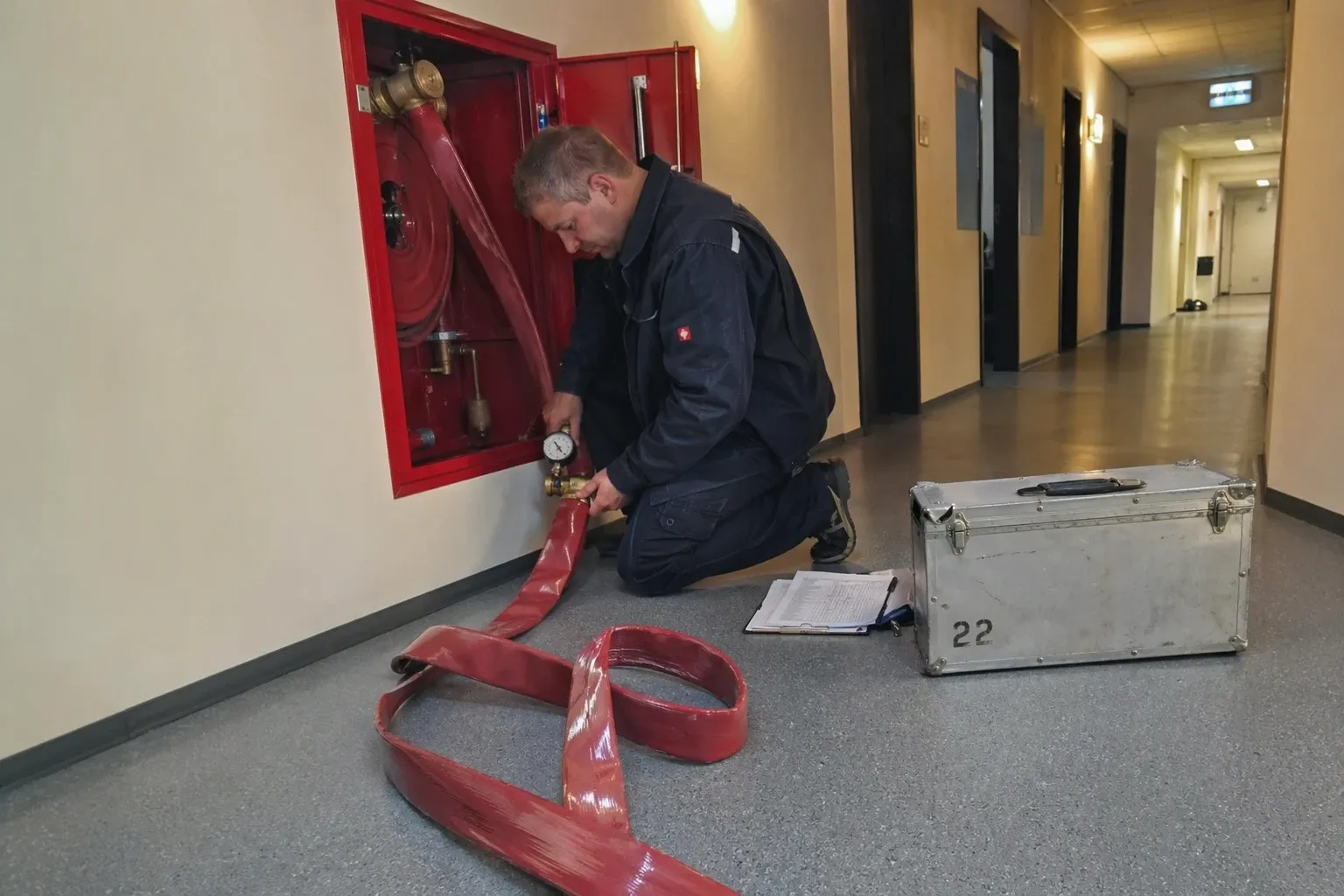
What is a wall hydrant?
A wall hydrant is a fixed fire-water take-off in the building — a cabinet with semi-rigid or flat-rolled hose, nozzle, shut-off valve and connection to the fire riser. Type S (self-help) for untrained users; type F (fire brigade) with higher flow for responders.
Wall hydrants complement extinguishers and enable longer, more sustained first-aid firefighting — "unlimited" while water supply holds.
Intervals in accordance with the applicable proofs of usability
applicable proof of usability "Maintenance" defines two mandatory intervals: annual service by a competent person with function, pressure and flow test. Every 5 years hose pressure test at 1.5× operating pressure in accordance with the applicable proofs of usability.
Interim checks by operator: monthly visual (access, marking, seal) — not normed but standard in service contracts.
What is tested annually?
Condition / visual: cabinet, lock, seal, hose damage, nozzle. Function: open valve, unroll hose, check jet. Measurement: flow rate at nozzle (type S ≥ 24 l/min at 2 bar; type F ≥ 100 l/min at 4.5 bar) and flow pressure. Documentation: protocol, new label, deficiencies.
Cost
Per hydrant: €35–75 for annual test. 5-yearly hose pressure test additionally — ca. €25–40 per hose incl. certificate. For larger sites (10+ hydrants) a flat-fee contract is cheapest.
Typical deficiencies and cost
Stuck hose (not unrolled) → replace: €80–150. Faulty valve → replace: €120–250. Blocked nozzle → clean/replace: €25–75. Leaky cabinet / missing seal → retrofit: €30–80.
Lessons from our NRW service contracts: in property stock older than 15 years, around 30 % of wall hydrants show at least one defect on inspection. The most common cause: the form-stable hose has never been unrolled — kinks stick the inside, and pressure collapses in the test. Prevention: annual unrolling is part of the mandatory inspection.
Risers: dry or wet?
The riser is the fixed water supply line in the building, to which the wall hydrant is connected. Two designs exist: dry risers are normally empty and filled by the fire brigade from outside in a fire — typical in non-permanently used buildings, underground car parks and stairwells. Wet risers stay permanently pressurised and deliver water immediately — typical in office buildings, hotels, hospitals.
Service differs: dry risers must be water-tested every 2 years per DIN 14462. Wet risers need annual function, pressure and flow checks at the hydrant plus regular flushing against stagnation. Drinking-water regulations (TrinkwV) require regular water exchange on wet risers without separation stations.
How a wall-hydrant inspection by Abels Brandschutz runs
We inspect wall hydrants across all of North Rhine-Westphalia — from office buildings in Düsseldorf to logistics halls on the Niederrhein. A standard inspection takes 15–25 minutes per hydrant: visual inspection of the cabinet and seal, function test of the shut-off valve, unrolling and visual check of the hose, flow-pressure measurement at the nozzle (manometer and flow meter), reassembly and resealing with a new inspection label.
On identifying a defect we document with photo, give an immediate recommendation (replace, repair, retrofit) and align the repair with the operator. Hoses with the 5-year pressure test about to expire are exchanged in the annual inspection — saving a separate visit.
For multi-site customers (property managers, hospital groups, industrial groups) we run a central digital register. You see per location which hydrant was last inspected and when the next 5-year pressure test is due.
Legal consequences and insurance
A missed wall-hydrant inspection regularly becomes a problem in a claim: the property insurer (often per VdS 2095) requires functional fire-protection equipment. If the wall hydrant could not be deployed in a fire because it was not operational, the insurer reduces the claim — for gross negligence up to full denial.
Administrative: building authorities and the surveyor for preventive fire protection check the maintenance documentation in inspections. Missing protocols are a defect under Building Code NRW (BauO NRW § 81) and may trigger administrative orders or fines.
For special buildings (hospitals, assembly venues, hotels), wall-hydrant servicing is part of the operating permit. Non-servicing may put the permit in question and in extreme cases trigger a closure order.