
Why is testing required?
Fire extinguishers are pressurised devices with agents whose properties degrade over time — powder may clump, foam may sediment, CO₂ may leak. Add mechanical stress, corrosion and tampering. applicable proof of usability "Portable fire extinguishers — maintenance" therefore mandates how and how often an extinguisher must be tested by a competent person.
The duty is codified via ASR A2.2 (Technical Workplace Rule) and BGR 133. Operators who skip testing lose insurance cover on incident and are personally liable.
Interval: every 2 years
applicable proof of usability clause 5 requires competent-person testing at most every 2 years. Shorter intervals are allowed (e.g. dirty industrial environments); longer are not.
Additionally: the pressure-vessel test per BetrSichV every 10 years for constant-pressure extinguishers, performed by an inspector, is a separate duty — not to be confused with the 2-year test.
After at most 20 years (constant-pressure), the extinguisher must be replaced — the vessel's service life is reached.
Who may test?
applicable proof of usability refers to the "competent person" — someone with proven training, theoretical and practical knowledge and a manufacturer qualification for the extinguisher type. Typically training by the manufacturer (Gloria, Minimax, Total) with regular re-certification.
The operator may not self-test — nor the company's fire-protection officer, unless specifically qualified for extinguishers.
What is tested?
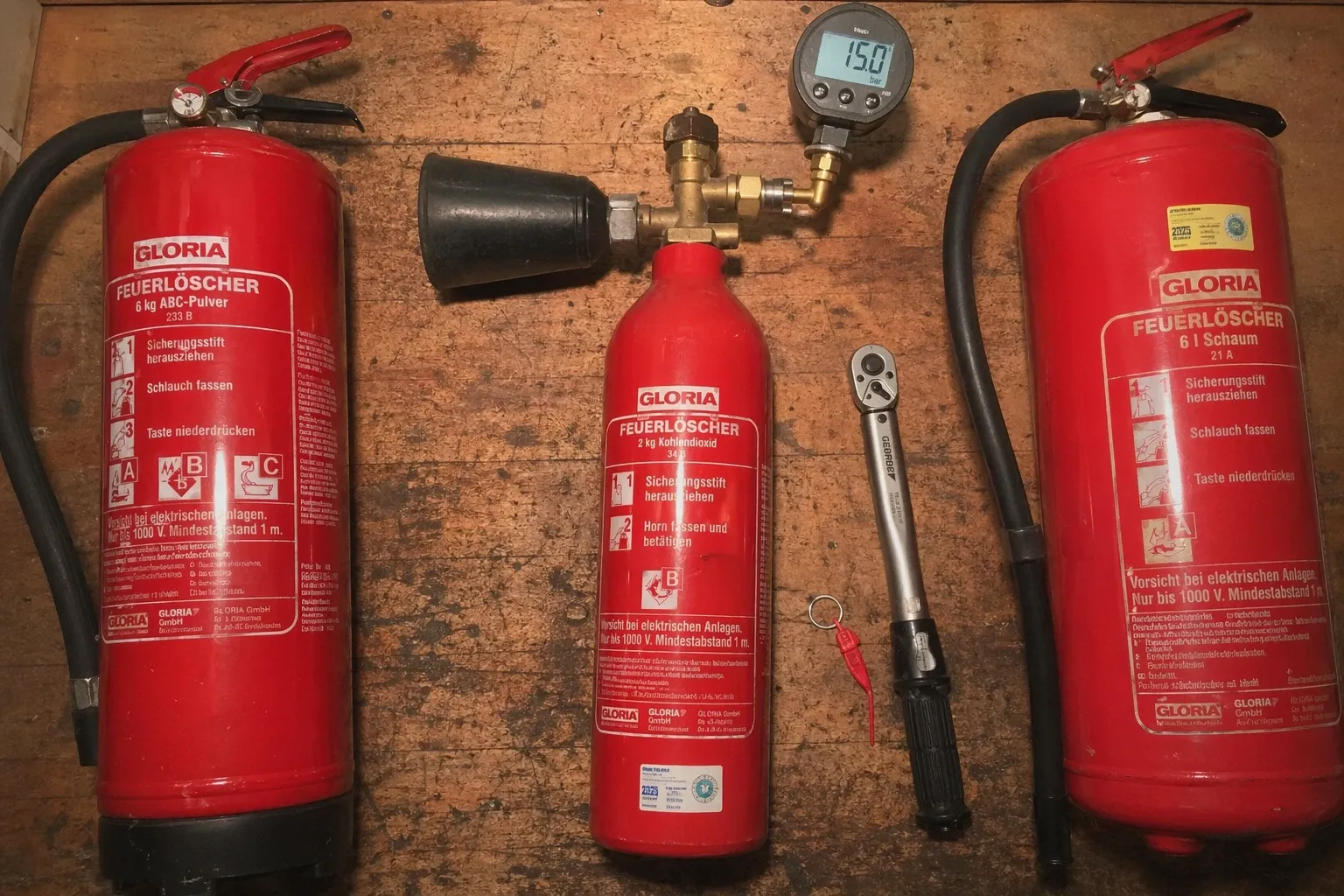
External visual: corrosion, dents, cracks, legible instructions, seal. Function check of actuation (strike button, cartridge, safety pin, manometer). Internal check where possible (always cartridge-type, manometer-only for constant-pressure). Check of agent for clumping, sedimentation or contamination. Check of hose, valve, nozzle. Finally a new label is attached and a protocol issued.
Cost
Per extinguisher: €12–25 for the test itself. Refill or parts add cost (powder ca. €20/kg, foam ca. €15/l, CO₂ per kg). For sites with 20+ units, volume discount or flat-fee service contract typical.
Service contracts with Abels Brandschutz reduce effective per-unit cost by 20–30% versus single-job billing because travel and setup are eliminated. For mid-sized companies in North Rhine-Westphalia with 30–80 extinguishers a contract almost always pays — typical annual flat-fee €600–1,200 net including inspection records, labels and a digital register.
Common defects during inspection
The most frequent issues we find on extinguishers in NRW property stock are: clumped powder caused by high storage humidity (underground garages, warehouses), corroded pressure vessels from outdoor storage without protection, expired propellant cartridges in cartridge-type extinguishers, damaged or missing seals on the actuation button, illegible instruction labels and worn type plates.
A rarely checked aspect: the bracket. Per ASR A2.2 the extinguisher must be visible, accessible at any time and mounted so the actuation parts sit no higher than 1.20 m above the floor. We document the bracket too — defects there count as a violation just like an expired extinguisher.
How an inspection by Abels Brandschutz runs
An extinguisher inspection by Abels Brandschutz follows a fixed sequence that is auditable for insurers and authorities. We arrive at the agreed appointment at your site in NRW, inspect each extinguisher individually using the 14-point protocol from the relevant proof-of-usability documents, log defects in a digital register and apply a tamper-proof label with the next inspection date.
Where defects are identified (clumped powder, low pressure, corrosion) you decide on site: repair, refill or replacement. Repairs are completed at our workshop in Borken; during the repair window we provide loan units at material cost. You then receive the inspection record as PDF, a defect summary and a recommendation for the next cycle.
For multi-site customers (property managers, retail chains) we operate a central digital register where you see per location which extinguisher was last inspected when — insurance audits become a formality.
Legal consequences of missed inspections
Anyone missing the 2-year inspection takes multiple risks: in a fire claim the property insurer (often per VdS 2095) reduces or denies cover because the fire-protection equipment was not 'operational'. For personal injury, civil liability (§ 823 BGB) shifts to the operator.
Administrative: during inspections by building authorities, trade-supervision offices or employer's liability insurers, fines of €500–10,000 per identified defect can apply, depending on state and severity. In NRW, regular inspections by district governments are particularly close-meshed for hospitals, schools and assembly venues.
Criminal liability arises after a fire with injuries or fatalities: prosecutors check for negligent bodily harm or negligent homicide, and an unchecked extinguisher is a central anchor in the expert report. The 2-year inspection is therefore not bureaucracy — it is self-protection.