
Three rule sets — which applies when?
DIBt (German Institute of Building Technology): Mandates annual service of manual fire doors via manufacturer recommendations — the typical "fire-door annual service". Basis: the system's approval (abZ / aBG).
ASR A1.7 (workplace rule): Governs testing of power-operated doors and gates in workplaces. Annual mandatory by competent person.
applicable proof of usability (automatic door systems): Defines safety requirements for automatic doors and is the basis for ASR A1.7 testing.
Manual fire door: DIBt service
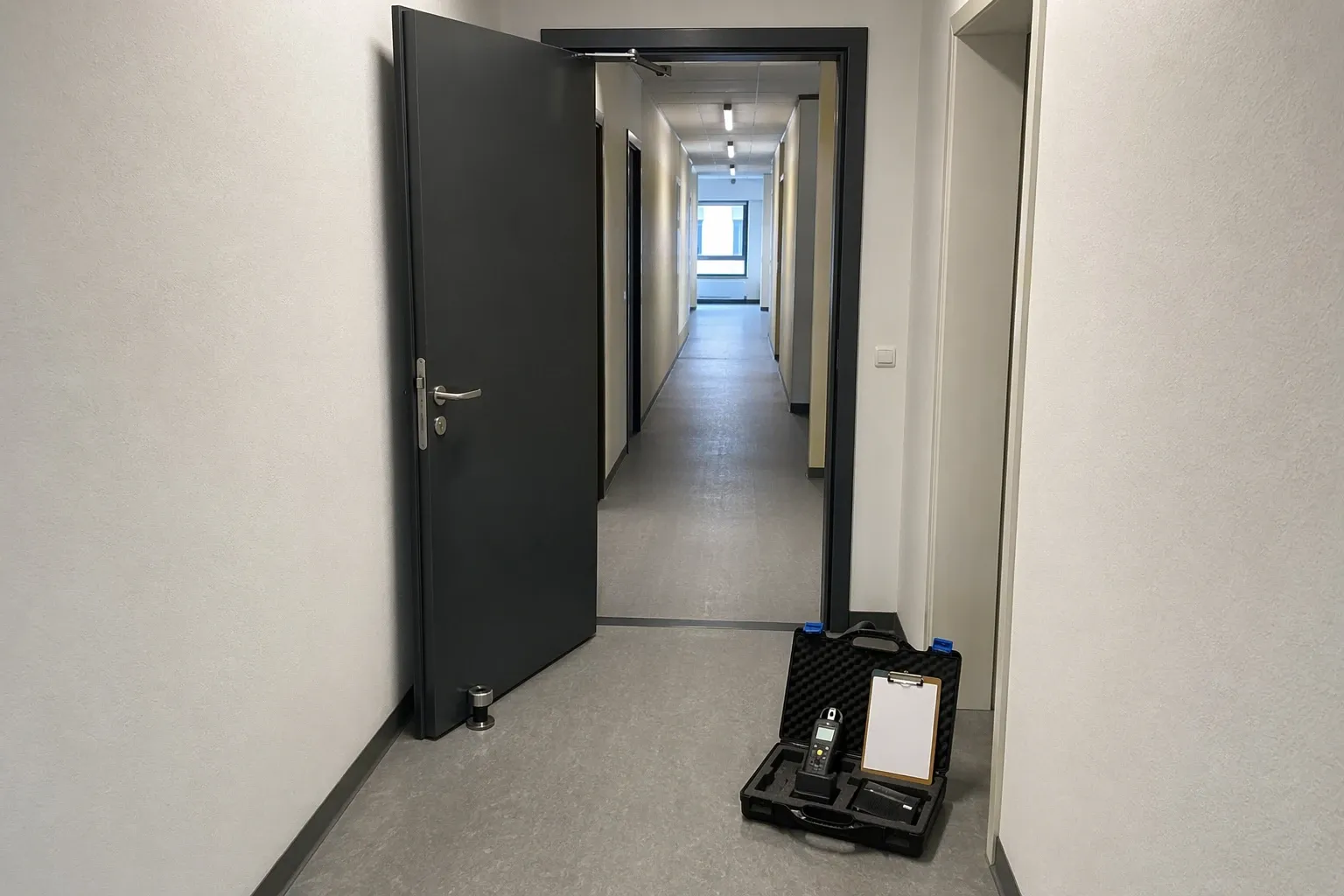
For manual fire doors (standard T30/T60/T90 with lever) annual service per manufacturer and DIBt approval (abZ/aBG) is mandatory. Checked: self-closing, seals, lever/lock, anchors, sequence controller, panic hardware if any. Tester must be trained for the manufacturer.
Powered fire door: ASR A1.7 + applicable proof of usability
For electrically or hydraulically powered fire doors, a legally binding safety test per ASR A1.7 is added. Checked: safety edges, closing protection, light barriers, mats, e-stop, closing-force measurement at main closing edge (≤ 150 N continuous, ≤ 80 N for weaker persons in accordance with the applicable proofs of usability).
Without a current protocol the door may not operate. On accident the operator is personally liable.
Who may test?
For both tests: specialist firm with manufacturer training and DIBt certification for the door system. Helpful: one company covering both, saving duplicate visits and paperwork.
Common findings
Throttled or defective closer (door doesn't fully close) — most common. Brittle or missing seals. Illegal wedge or hold-open strap — common in offices, but a critical defect. Painted frames without seal-slot adjustment. Retrofitted stoppers or hardware without manufacturer release.
From the Abels Brandschutz inspection records: in NRW property stock older than 10 years, around 35 % of fire doors carry at least one defect. For schools and public buildings the rate climbs to 50 % because doors there see heavier mechanical use — stairwell doors, classroom closures, lobby doors.
Cost and contract models
A single inspection of a manual fire door typically costs €35–65 net; a power-operated door with ASR A1.7 inspection €80–150. Repairs — failed closer, new seal, hardware swap — are itemised separately, with material price plus time.
From around 8–10 doors a service contract with annual flat-fee pays. Example: mid-sized industrial site with 35 manual and 6 power-operated fire doors — typical annual flat-fee €2,000–2,800 net, including emergency-priority response, digital register and a dedicated contact.
Service contracts with Abels Brandschutz include by default: annual inspection of every door, half-yearly visual check on power-operated installations, priority emergency service within 24 h across NRW, digital door cadastre with photo archive, automatic reminder of recurring inspections, advice on rebuilds and retrofits.
How a fire-door inspection by Abels Brandschutz runs
A standard door inspection takes 12–20 minutes per door; a power-operated door with ASR A1.7 safety check 25–40 minutes. We arrive at the agreed appointment at your site — anywhere in North Rhine-Westphalia — and work door-by-door through an 18-point protocol: identification of the door via type plate, visual check of frame and leaf, function test of the closer, closing sequence on double-leaf doors, seals, handle and lock, panic hardware, plus safety strips and light barriers on power-operated doors.
On finding a defect we document with photo, classify by severity (A=immediate, B=soon, C=note) and align the repair directly with the on-site contact. Small defects — closer adjustment, seal swap, strike-plate alignment — our technicians fix the same day. Larger repairs are listed in the service report and ordered separately.
At end of day you receive a PDF service certificate listing every door inspected, the next due date and a clear defect table. In the digital door cadastre you see every intervention, every photo, every part — a watertight record for insurers, building authorities and surveyors.
Legal consequences of missed door inspections
A missed fire-door service has the same legal weight as for other fire-protection equipment, but is more visible in a claim than for hidden installations like SHEV or seals. Anyone unable to produce a current service certificate during a claim faces significant deductions — insurers cite VdS 2095 and DIN 14096 (Fire Protection Order).
For power-operated doors there is an extra angle: without a current ASR A1.7 record the door must not be operated in automatic mode. Doing so anyway and causing personal injury (trapped person, closing-force injury) means personal liability under § 823 BGB, and the employer's liability insurer reviews under § 3 ArbSchG for an administrative offence.
In NRW special buildings (hospitals, schools, assembly venues) annual door servicing is part of the operating permit. District governments check service documentation in regular inspections. Where it is missing, the permit may be questioned — with conditions up to partial closure.