
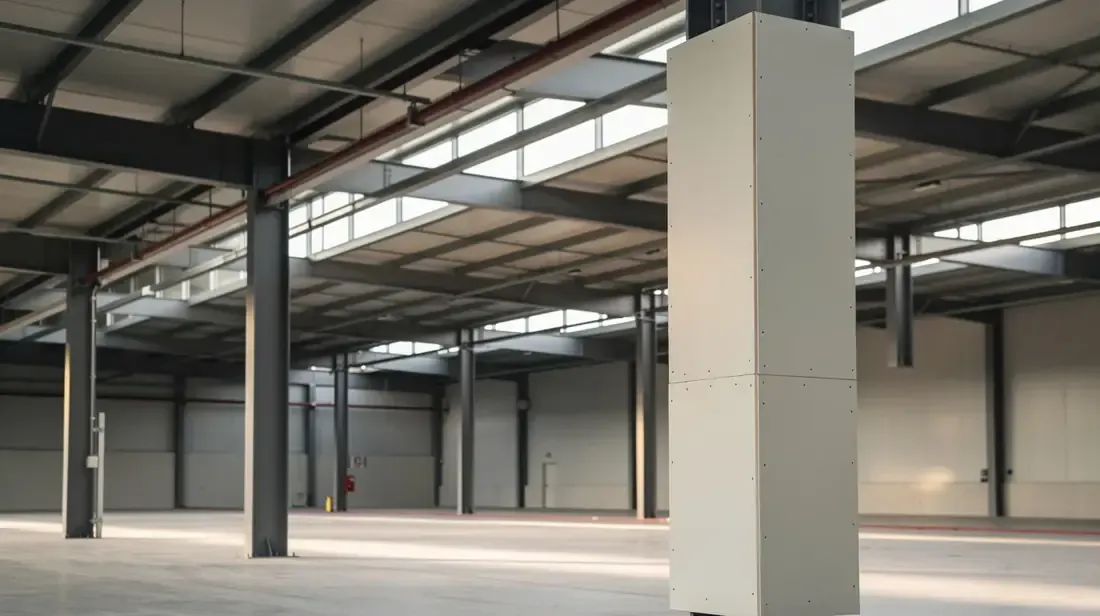
The core principle
Fire protection for a steel structure has one clearly defined goal: keep the steel temperature below a critical limit for a specified duration. Above that limit steel loses its load-bearing capacity, and the member fails.
The required duration is expressed as a fire-resistance class in minutes — R30, R60, R90, R120, R180 or R240. Which class applies in a given project follows from building type, use, and the relevant building code.
- Goal: hold steel temperature below the critical limit
- Classes: R30 / R60 / R90 / R120 / R180 / R240 minutes
- Driven by: building type, use, building code
- Evidence: a tested system with a valid approval
The four systems at a glance
Four systems have established themselves for protecting load-bearing steel members. Each has its own strengths — there is no single “right” system, only the one that best matches geometry, aesthetic demands and the site conditions.
| System | Material | Key trait | Appearance |
|---|---|---|---|
| Fire protective boards | Calcium silicate or calcium sulphate boards, fibre-reinforced | Factory-made, fast to install | Closed cladding |
| Intumescent coatings | Reactive coating | Expands to ~50× in a fire | Steel geometry stays visible |
| Fire protective sprays | Cement/gypsum binders with fillers and fibres | Adapts to complex geometry | Plaster-like, form-following |
| Membrane systems | Surface-based fire protection | For complex ceilings and composite structures | Suspended or laid-in surfaces |
Fire protective boards
Fibre-reinforced calcium-silicate or calcium-sulphate boards are produced in the factory under controlled conditions. That delivers tight tolerances and consistent quality — something that is not easily reproduced on a construction site.
- Single-layer cladding is sufficient for most applications
- Direct installation without metal rails or complex supporting systems
- Minimal drying times — no waiting for the next trade
- Easier quality inspection because installation is straightforward
- Lower weight and transport volume
- Cut, screw and staple — year-round, with no temperature or humidity limits
Intumescent coatings
Intumescent coatings are applied like paint and remain practically invisible under normal conditions. When exposed to heat they react chemically, expand to roughly 50× their original volume and form an insulating carbon foam that keeps the steel temperature under control.
- Steel geometry stays visible — ideal where architecture shows the steel
- Customisable in colour and finish
- Works even on complex members and connection nodes
- Application only under controlled conditions (temperature, humidity, substrate)
- Multiple coats with proper drying time between them
- Expansion space must stay free — no covering with rigid materials
Fire protective sprays
Sprays are powder systems of cement- or gypsum-based binders with fillers and fibres. They are mixed on site and applied by machine — which lets them adapt to almost any geometry.
- Highly adaptable to complex beams, columns and connection nodes
- Acceptable as a plaster-like finish when executed properly
- Covers critical connection points cleanly
- Requires on-site mixing equipment and masking of surrounding elements
- Controlled drying conditions required
- Extensive thickness verification for handover — every position must hit the minimum thickness
Membrane systems
Membrane systems take an alternative approach: they form a continuous protective surface and are particularly useful for complex ceiling geometries or composite (steel-concrete) structures — where cladding each profile individually would be uneconomic or geometrically impractical.
Instead of wrapping every steel member, the protection is suspended as a plane beneath — a clean solution in ceilings.
European test standards
The performance of a fire-protection system for steel structures is demonstrated against harmonised European standards in a fire test. Three central references:
- applicable proof of usability — testing of membrane and ceiling protection systems
- applicable proof of usability — testing of vertical fire-protection systems for load-bearing members
- applicable proof of usability — fire resistance of load-bearing elements: floors and roofs
Which system when?
The choice is rarely free — it follows three drivers: the required fire-resistance class, architectural aesthetic demands and the site conditions. A handful of rules of thumb for an initial read:
- Want visible steel? → intumescent coating
- Complex, cluttered geometry? → spray or coating
- Fast, weather-independent installation required? → boards
- Large ceiling areas with many individual profiles? → consider membrane
- High fire-resistance class (R120 / R180 / R240)? → dimension thickness and system together